

Shortage of skilled labor in logistics – Proactively Addressing Challenges

Denise List

At a Glance

The Shortage of skilled labor in logistics calls for new approaches. Learn how companies can take proactive steps and develop sustainable solutions.

First published June 30, 2026

The Shortage of skilled labor in logistics is no longer just a future issue; it is already a key challenge for companies today. A study by “Die Wirtschaftsmacher” (2024) makes it clear that a clear majority of companies view the shortage of skilled workers and managers as a business-critical issue for the future—yet while strategic and long-term HR approaches are being expanded, they have so far often been implemented only incrementally.

Yet qualified personnel are already in short supply today. There is a growing demand for generalists who can work across disciplines, take on responsibility, and drive new business models forward.

Policymakers can make a significant contribution to mitigating the Shortage of skilled labor—but that alone is not enough. Companies themselves are also called upon to take active measures.

Here at MÜLLER | DIE LILA LOGISTIK, we also face these challenges every day—and are happy to share our experiences and solutions.

The Shortage of skilled labor in logistics must be rethought

Qualified personnel are already hard to find today. At the same time, requirements are rising: There is an increasing demand for generalists who can work across disciplines, take on responsibility, and drive new business models forward.

The Shortage of skilled labor is thus evolving from a quantitative to a qualitative problem. It is no longer just a matter of filling open positions—but of having the right skills available at the right time.

What developments are exacerbating the Shortage of skilled labor?

Technological and structural changes are bringing about lasting shifts in the labor market. Trends such as Industry 4.0, the Internet of Things, robotics, and data-driven automation are reshaping not only job requirements but also role models.

Companies are facing new questions:

  • Which skills will be crucial in the future?
  • How are technologies changing employer attractiveness?
  • Which jobs will be replaced—and which new ones will emerge?

These developments make it clear: The Shortage of skilled labor is not an isolated HR issue, but part of a comprehensive transformation of organizations and value creation.

Actively Addressing the Shortage of Skilled Labor 

There is no one-size-fits-all solution to the Shortage of skilled labor in logistics. Nevertheless, key starting points can be identified that companies can use to systematically counteract the problem.

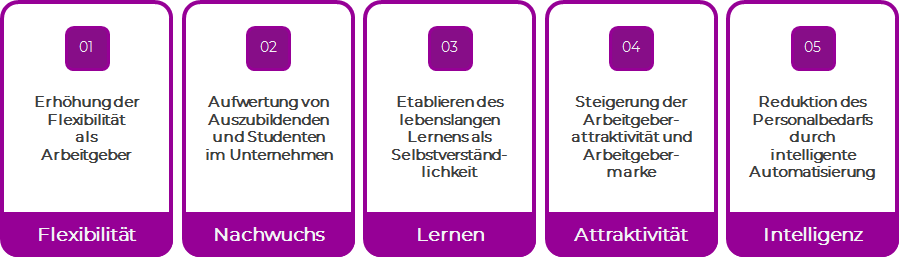
Five Approaches to Addressing the Shortage of Skilled Labor in Logistics


Ansätze-gegen-den-Fachkräftemangel-Logistik


1. How can greater flexibility help attract skilled workers?

Expand your search radius beyond your company’s location and use digital platforms for nationwide recruitment. In addition, relocation assistance or housing options can make it easier for candidates to choose your company.

Flexible work models also increase attractiveness: working from home, job sharing, and part-time arrangements enable a better work-life balance. This requires a high degree of trust in self-managed work.

2. How can companies develop their own workforce in a targeted manner?

Building up a company’s own pool of skilled talent is becoming increasingly important. This involves involving trainees and students early on and assigning them specific areas of responsibility.

Clear tasks, structured expectation management, and regular feedback help develop potential more quickly and retain talent in the long term.

3. Why is lifelong learning becoming a critical success factor?

Increasing complexity, shorter product life cycles, and intense pressure to innovate require continuous professional development.

Knowledge is increasingly becoming a key competitive factor. Companies should therefore make targeted investments in continuing education and embed learning as an integral part of their corporate culture.

4. What role does Employer Branding play in the Shortage of skilled labor?

Recruiting and retaining employees is becoming increasingly costly and time-consuming. A strong employer brand is thus becoming a decisive competitive factor.

In addition to compensation, intangible factors play a particularly important role: appreciation, leadership culture, flexible work models, and opportunities for development.

Employer Branding does not yield immediate results; rather, its impact unfolds through continuous and authentic implementation.

5. How can automation and outsourcing help reduce the Shortage of skilled labor in logistics?

Digitalization and automation enable companies to streamline processes and manage staffing needs in a targeted manner. Standardized workflows, intelligent systems, and data-driven management reduce the burden of manual tasks and ease the workload on existing teams.

Another lever lies in the targeted outsourcing of logistics services. Companies can outsource tasks for which sufficient internal resources or expertise are not available. While this does not completely solve the Shortage of skilled labor, it significantly alleviates it.

As a logistics service provider, we have well-established processes, specialized teams, and scalable structures that enable stable operations even with limited staffing resources.

In particular, outsourcing logistics services to us helps companies bridge staffing gaps and structurally relieve their organization of the burden caused by the Shortage of skilled labor.

The key point:
Addressing the Shortage of skilled labor is not just a matter of recruitment, but also of the structural design of processes, capacities, and value creation

Conclusion: Actively Addressing the Shortage of Skilled Labor

The Shortage of skilled labor in logistics cannot be solved with isolated measures. What is crucial is a holistic approach that integrates recruiting, workforce development, corporate culture, and structural measures.

Companies that take a proactive approach today—rather than merely reacting—secure decisive long-term competitive advantages.

Here’s how LILA can provide concrete support

If you’re wondering how to specifically alleviate the Shortage of skilled labor in your logistics operations, we’re here to support you as your partner:

  • We analyze your existing processes and identify bottlenecks
  • We develop scalable logistics concepts that function independently of the labor market
  • We take on clearly defined logistics services and provide targeted relief for your organization

Talk to us—we’ll show you how to structurally resolve the Shortage of skilled labor.


FAQ


Call to Action passend zum Artikel

Sprechen Sie persönlich mit uns über Ihre Bedürfnisse
oder informieren Sie sich weiter über unsere Leistungen

Jetzt Kontakt aufnehmen