
Outsourcing Your Plant Logistics
First published: October 26, 2023 Logistics is the third-largest economic sector in Germany, after the automotive industry and retail. Across all...
Denise List
In diesem Beitrag erfahren Sie, wie das vorgestellte Modell in der Praxis wirkt — von der ersten Analyse bis zum messbaren Ergebnis im operativen Tagesgeschäft.
Inhaltsverzeichnis
Lade Inhaltsverzeichnis …
First published June 30, 2026
“Make-or-Buy” describes the decision to either provide logistics services in-house or outsource them to external partners.
In logistics, this decision affects a wide range of areas—from Warehousing and transportation to production-related services, Value Added Services, and complete process chains.
It’s not just about individual tasks, but often about the fundamental question of how logistics processes are organized and managed.
Supply chains have become significantly more complex in recent years.
Increasing demands for flexibility, speed, and transparency mean that traditional, established structures are increasingly reaching their limits.
At the same time, the role of logistics is changing:
it is seen less as a support function and is increasingly making a direct contribution to value creation.
This makes “Make-or-Buy” a structural issue.
It is no longer just about costs, but about how logistics must be organized to ensure efficiency, stability, and adaptability.
Outsourcing makes sense above all when companies can no longer provide logistics services with the necessary efficiency, flexibility, or scalability within their own structures.
Typical situations include:
Outsourcing does not simply mean shifting tasks; rather
, it involves providing services where they can be integrated most effectively from both an organizational and operational perspective.
In practice, Make-or-Buy decisions cover a broad spectrum of logistics services.
These include, among others:
Often, it’s not about isolated activities, but rather about bundling multiple services into an integrated process structure.
Outsourcing not only leads to a different distribution of tasks but also changes the structure of logistics.
Typical changes include:
As a result, logistics is no longer organized in isolation within a company but is managed across multiple structures.
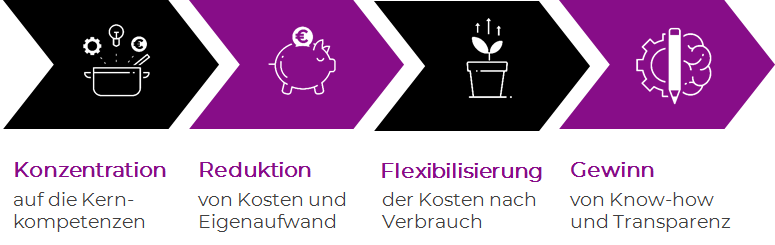
Outsourcing creates leeway within a company’s own organization.
Services are strategically outsourced so that companies can focus more strongly on their core competencies.
At the same time, the logic of value creation is changing:
What matters here is not the outsourcing itself, but its impact on the entire Supply Chain.
Outsourcing can help relieve pressure on structures, stabilize processes, and sustainably increase performance.

The real challenge lies in implementation.
In practice, this means:
Only when this integration is successful can stable and efficiently managed processes be created.
Make-or-Buy is not an isolated decision-making issue, but rather part of a holistic view of logistics.
The focus is on structuring logistics services so that they function as an integrated solution within the Supply Chain.
This involves combining various individual services and implementing them operationally.
The goal is to create stable, scalable structures that alleviate the burden on processes and can be further developed over the long term.
In this way, logistics is not merely organized but specifically leveraged as part of the value creation process.
Make-or-Buy is not an isolated decision, but a key lever for shaping logistics.
Outsourcing changes responsibilities, workflows, and the organization of services along the Supply Chain. When implemented
correctly, this results in clear structures that improve efficiency, flexibility, and stability.
As a partner, LILA supports the practical implementation of these structures.
The focus is on integrating logistics services into effective end-to-end solutions and on developing processes that are sustainable in the long term.
The goal is to utilize logistics in a way that makes a measurable contribution to value creation and sustainably strengthens the Supply Chain.
"Make-or-Buy" refers to the decision of whether to provide logistics services in-house or outsource them to external partners. This decision influences the structure and management of the entire Supply Chain.
Outsourcing makes sense when internal structures reach their limits, flexibility needs to be increased, or services can be integrated more efficiently into external processes. The key factor is the impact on the efficiency, structure, and stability of logistics.
Typical services include Warehouse logistics, transportation processes, Value Added Services, returns logistics, and production-related supply processes.
The biggest challenge lies in implementation. Outsourced services must be seamlessly integrated into existing processes to ensure stable operations.
Head of Content & Communications
Sprechen Sie persönlich mit uns über Ihre Bedürfnisse
oder informieren Sie sich weiter über unsere Leistungen
First published: October 26, 2023 Logistics is the third-largest economic sector in Germany, after the automotive industry and retail. Across all...
First published: June 30, 2026 Why Supply Chain Management Often Fails In many companies, workflows have evolved over time—organized by department...
First published: June 30, 2026 What Are Value Added Services in Logistics? Value Added Services (VAS) refer to additional services provided...