

4PL Logistics — How Are Complex Supply Chains Managed in an Integrated Manner?
First published: June 30, 2026 What Is 4PL Logistics, and Why Is It Becoming More Important? The increasing complexity of modern Supply Chains is...
Denise List
Many companies today are struggling with rising inventory levels, a lack of transparency along the Supply Chain, and high manual management costs. Supply Chain 4.0 addresses precisely these issues—as a further development of existing Value-added processes. In practice, it’s clear that digital solutions deliver the greatest value when processes, roles, and decision-making logic are clearly defined in advance. -> Learn more about value creation in logistics
Inhaltsverzeichnis
Lade Inhaltsverzeichnis …
First published: June 30, 2026
Supply Chain 4.0 describes the evolution of traditional logistics into modern, cross-organizational supply chain management—supported by digital technologies such as big data, the Internet of Things, 3D printing, and augmented reality. The goal is to achieve an overall optimization of the value chain, in which processes are implemented as seamlessly as possible from the supplier to the end customer.
Traditional logistics—which focused on individual organizations and took the form of transportation, handling, and warehousing services—has evolved into modern, cross-organizational supply chain management. Increasing demands from customers, employees, and partners require the entire value-added process to become more reliable. Instead of a sum of individual optimizations, the goal is to achieve an overall optimization of the value chain, in which processes are implemented as seamlessly as possible from the supplier to the end customer—that is, across all procurement and sales stages.
As a result, it is no longer individual companies that compete with one another, but rather the performance of their entire network. Supply Chain Management enables companies to tap into cross-network potential for success by developing, designing, steering, and implementing effective and efficient flows of goods, money, and information. Digitalization is playing an increasingly crucial role in this context.
Why Companies Invest
in Their Supply Chains The question of whether Supply Chain 4.0 is science fiction can be answered quickly: Technologies such as big data, the Internet of Things, 3D printing, and augmented reality are part of our working world today. The economic benefits of a well-managed Supply Chain are measurable. Companies that consistently implement transparency and digital management strengthen the performance of their entire network—and unlock cross-network potential for success.

The Supply Chain is full of digital possibilities. Much of this is already a reality, while some aspects are still a long way off. Not every idea will be suitable for every company or directly applicable. But they provide a good opportunity to examine your own Supply Chain with regard to the potential use of digital technologies.
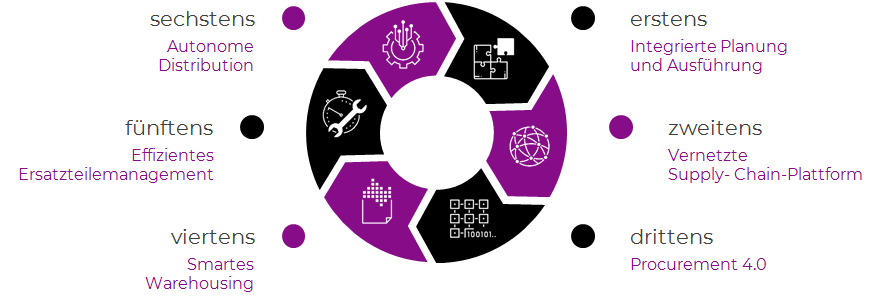
The central goal of supply chain management is to deliver the right product to the end customer at the right time. This requires ensuring both the flexibility and reliability of material flows as well as low Transaction costs. To achieve this, we at LILA are creating a foundational infrastructure that simplifies the integration of planning and execution activities along the Supply Chain:
Only when these systems are not just used individually but are interconnected via a single platform can their full potential be realized.
The exchange of information among all stakeholders is of enormous importance. By integrating internal and external data, digital platforms serve as a central control and monitoring hub for all Supply Chain participants—from pickup at the supplier to delivery to the customer.
All communication, tracking, and control of your Supply Chain can be managed via a cloud platform. It connects multiple systems, giving you a constant overview of all processes along the value chain, notifying you of anomalies in real time, and enabling you to respond promptly through escalation management. Once the integrated platform is in place, it significantly reduces the overall planning effort and generates substantial added value. We support you with our expertise as you build your platform.
Digitalization is redefining purchasing and procurement processes. Forward-looking market and supplier analyses, Co-creation—that is, the involvement of suppliers in product development—and electronic contract execution open up new opportunities for purchasing and increase its importance for the strategic success of the Supply Chain. A key factor here is the integration of upstream and downstream stakeholders to boost process efficiency along the entire value chain.
Smart Warehousing refers to the intelligent automation of warehouse operations. Various technologies are used to connect automated processes so that they mesh seamlessly through mutual data exchange. The goal is to increase warehouse productivity while simultaneously reducing the error rate in manual handling. Every warehouse is a key hub in the Supply Chain—Smart Warehousing therefore impacts the entire Supply Chain, from Inbound Supply Chain to Outbound Supply Chain.
An operational scenario: On their way to the warehouse, trucks automatically communicate their current location and estimated time of arrival to the warehouse management system. In the warehouse, all inventory levels are updated in real time via sensors. Driverless transport systems store the goods without any additional intermediate steps—while simultaneously automatically recording all data in the system.
Spare parts management is becoming increasingly important in the context of Supply Chain 4.0. In many industries, a large portion of all orders consists of requests for spare parts—with extremely irregular demand. 3D technology offers a forward-looking approach here: There is no need for labor-intensive pre-production or long-term storage. Spare parts requested by customers can be produced within minutes. The investment costs pay for themselves quickly through savings on storage costs—and the reduced need for goods handling creates further potential for savings.
The Shortage of skilled labor and the rising volume of freight are making it increasingly difficult for companies to meet all customer requests. In warehouses, autonomous transport vehicles will continue to gain importance. Digitalization is also creating new transportation options in road traffic: the first self-driving trucks are already on the road. In the long term, the economy cannot do without these technologies—their implementation in day-to-day business is only a matter of time.
Based on our experience, the following success factors are recommended when implementing a smart Supply Chain:
At LILA, Supply Chain 4.0 is the consistent further development of existing value-added processes. Well-thought-out processes form the foundation—automation and digital control reinforce what already works. We start by working together to understand the actual workflows and decision-making logic—and then systematically implement the solution.
Supply Chain 4.0 is a reality—and a matter of getting the order right. Those who first understand processes, then design them, and finally support them digitally unlock the full potential of their value chain. At LILA, we combine this understanding of processes with operational implementation expertise—together with our customers.
Supply Chain 4.0 describes the evolution of traditional logistics through digital technologies such as big data, the Internet of Things, and networked control systems—with the goal of achieving end-to-end optimization from the supplier to the end customer.
Traditional logistics focuses on individual activities such as transportation, handling, and warehousing. Supply Chain 4.0 connects all stakeholders through a shared database and aims to achieve overall optimization of the value chain.
Companies are tapping into cross-network opportunities for success: higher on-time delivery rates, shorter lead times, lower transaction costs, and better integration of all stakeholders along the value chain.
LILA starts with a shared understanding of real-world workflows, interfaces, and decision-making logic. Well-designed processes form the foundation—the right digital solution follows from that.
Head of Content & Communications
Sprechen Sie persönlich mit uns über Ihre Bedürfnisse
oder informieren Sie sich weiter über unsere Leistungen
First published: June 30, 2026 What Is 4PL Logistics, and Why Is It Becoming More Important? The increasing complexity of modern Supply Chains is...
First published: June 30, 2026 Why Supply Chain Management Often Fails In many companies, workflows have evolved over time—organized by department...
Global Supply Chains are undergoing a transformation. Increasing complexity, geopolitical risks, volatile markets, and growing regulatory pressure...